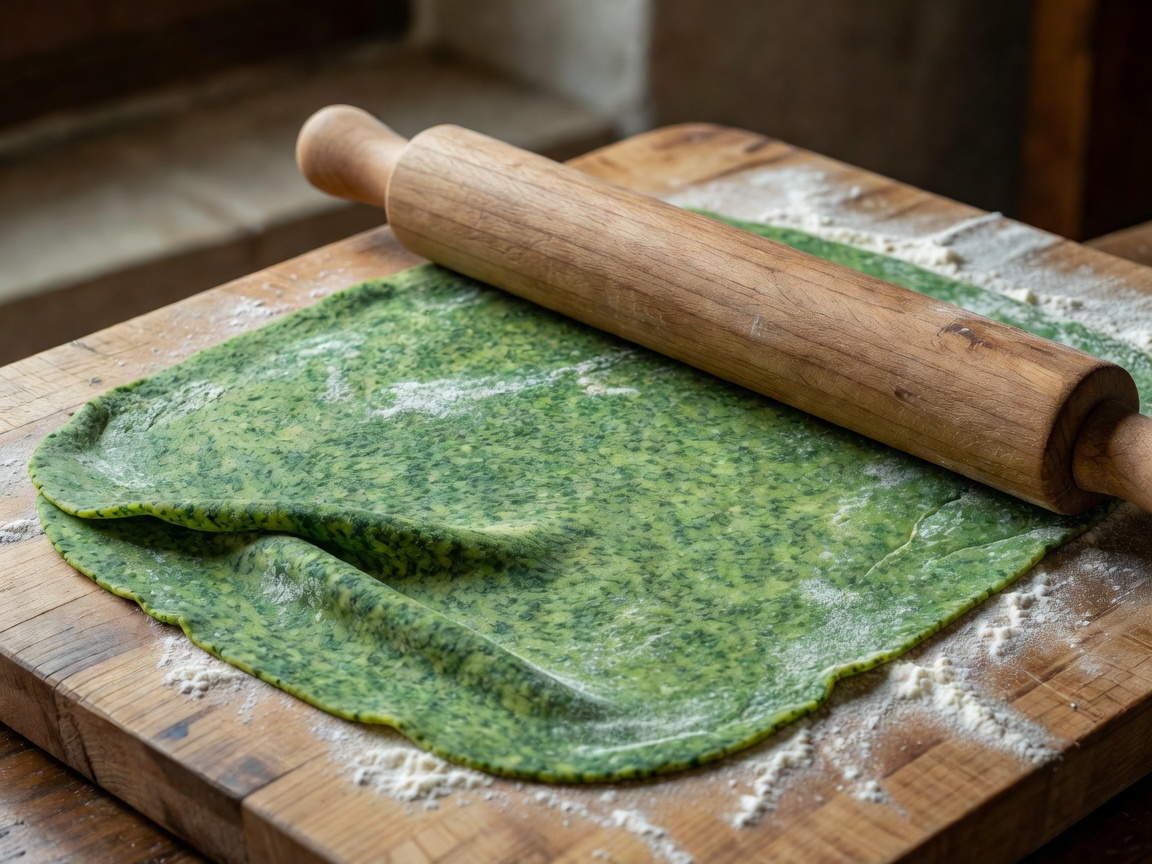
The Regional Pride: Yellow vs. Green Sfoglia
While international home cooks typically associate lasagne with golden yellow egg pasta, the official historical standard in Bologna is green: Lasagne Verdi alla Bolognese. Fresh spinach leaves are blanched, thoroughly drained of every drop of liquid in a linen towel, pureed into a fine paste, and worked into the dough alongside farm-fresh eggs and Italian Tipo 00 soft wheat flour.
The spinach is not merely decorative. It contributes subtle minerals, chlorophyll freshness, and vegetable moisture that balances the richness of the meat ragù and velvety béchamel. If you choose standard golden dough, ensure you use pasture-raised eggs with deep orange yolks to achieve the rich chew characteristic of Emilian pasta.
Flour Grading and Gluten Network Development
Unlike dry southern pasta shapes, which rely on coarse durum wheat semolina and water, fresh Northern Italian sfoglia requires finely ground soft wheat flour (Tipo 00). The powdery texture of Tipo 00 absorbs liquid quickly, while moderate protein levels (between 11% and 12.5%) create an elastic, pliable gluten matrix that rolls out paper-thin without tearing or springing back.
Hydration Rule for Spinach Dough
When making green pasta, do not simply add spinach to a standard recipe. Cooked spinach contains roughly 90% water by weight. For every 100g of flour, use approximately 50g of whole egg plus 25g of thoroughly squeezed, finely pureed spinach. If your dough feels sticky, dust it lightly with extra flour; if it crumbles, knead with lightly dampened hands until smooth.
Step-by-Step Dough Preparation and Rolling
Follow these proven steps to achieve professional texture:
- The Well Method (Fontana): Mound 400g of Tipo 00 flour directly onto a rough wooden board. Create a wide, deep well in the center using your fingers.
- Emulsify the Liquids: Crack 4 large eggs (or 3 eggs plus 80g pureed dry spinach) into the well. Using a fork, beat the eggs gently while pulling small amounts of flour from the inner walls.
- Knead to Uniformity: Once a shaggy dough forms, use a bench knife to gather all scraps. Knead firmly using the heel of your palms for 10 to 12 minutes until the ball is silky, smooth, and rebounds slightly when pressed.
- Mandatory Rest: Wrap the dough tightly in beeswax wrap or clingfilm. Let it rest at room temperature for at least 45 minutes. This allows the gluten bonds to relax and the starch granules to fully hydrate.
- Sheeting to Gauge: Divide into four portions. Keep unused dough covered. Roll using a long wooden rolling pin (mattarello) or pass through an Italian hand-crank pasta roller down to setting #6 or #7 (approx. 0.8mm to 1.0mm thickness).
- Portioning: Cut the rolled sheets into neat rectangles matching the dimensions of your baking pan (approx. 10cm x 20cm).
To Boil or Not to Boil: The Parboiling Debate
Commercial "oven-ready" dry noodles claim no boiling is necessary. However, in artisanal cooking, fresh homemade sheets require a brief blanching step. Freshly made pasta sheets absorb sauce liquid as they bake. Parboiling them ensures your lasagne finishes moist and tender rather than dry and dense.
Brief Parboiling (The Authentic Method)
- Cook sheets for 45 to 60 seconds in boiling salted water.
- Immediately shock in an ice-water bath to stop residual cooking.
- Lay flat on clean, lint-free cotton kitchen towels to dry.
- Result: Perfectly hydrated pasta that bakes evenly without absorbing sauce moisture.
Direct Raw Assembly
- Layering raw fresh pasta directly into the pan.
- Requires exceptionally loose, watery béchamel and ragù to cook the noodles.
- Can lead to unevenly cooked pasta sheets and dry, rubbery edges.
- Higher risk of soggy pockets or undercooked, chalky pasta in the center.
Technical Specifications: Fresh vs Dry Sheets
| Characteristic | Handmade Fresh Egg Sfoglia | Commercial Dry Durum Lasagne | Oven-Ready No-Boil Sheets |
|---|---|---|---|
| Flour Basis | Tipo 00 Soft Wheat + Eggs | Durum Wheat Semolina + Water | Extruded Semolina (Pre-gelatinized) |
| Cooked Texture | Silky, delicate, merges into sauce | Firm, toothsome, distinct chews | Can be dense, gummy, or brittle |
| Sauce Adherence | High (Rough micro-porous surface) | Moderate (if bronze extruded) | Low (Smooth Teflon extruded) |
| Blanching Time | 45–60 Seconds | 4–6 Minutes | 0 Minutes (Requires excess sauce) |
Once blanched, shocked, and dried on kitchen towels, the sheets are ready for assembly. Handle each sheet gently with dry hands to prevent tearing or bunching.